




Empowering your business with intelligent systems that learn, automate, and scale.
Turn your data into a decision-making powerhouse.
Modern, secure, and scalable cloud infrastructure for growth-ready businesses.
From idea to execution — we build world-class digital products.
Transform your operations and roadmap with high-impact technology strategy.
Where creativity meets usability — we design digital journeys that convert.
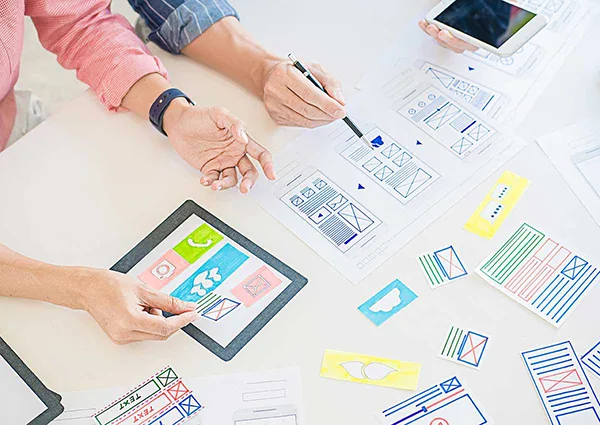
Our UI UX Design supports companies of all sizes, from start-ups to industrial companies. Our specialty? Develop useful and intuitive user interfaces and paths. In a word, make complex subjects simple. We create experiences that forge lasting relationships with your audiences and solutions that maximize your sales . The little extra: our teams integrate former developers.


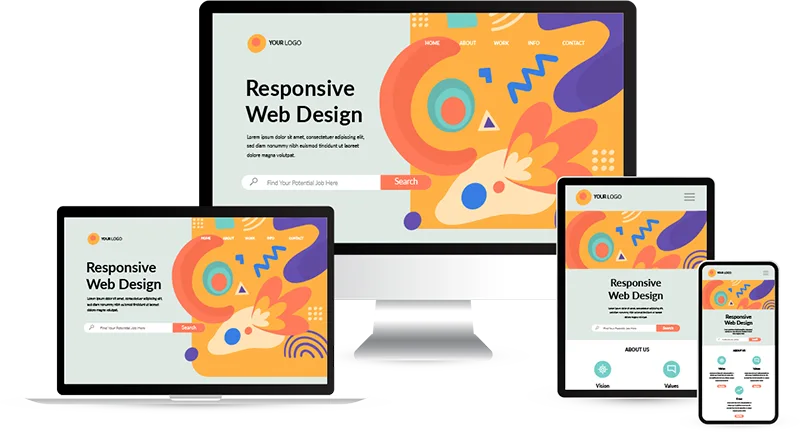
We design attractive, ergonomic and accessible interfaces for mobile and e-commerce. Our increased knowledge of technology accompanies you at each stage of your project to activate the best growth levers and Ui/Ux Design Bootcamp.
Our ui/ux design process is different from other ui us design agency. We believe in quality and live data.
Designing an ergonomic interface means offering your users a fluid and pleasant experience that gives visibility to your offer. It is this experience that creates lasting bonds with your audiences.
The interfaces are systematically tested to confront them with the reality of the market. We are in continuous interaction with your technical teams to create feasible, affordable and efficient projects
We design your digital identity in the form of a library of pre-chartered graphic components: your identity is centralized and you no longer need to recreate the same elements each time for your site.
Assess your needs, understand who you are and in which market(s) you operate in order to ask the right questions. On the program: audit, benchmark, Big Data, market studies, barometers & brainstorming.
We analyze the behavior of your users when they interact with your product thanks to the study of your customers (interviews, focus group, etc.) and your analytics.
Designing an ergonomic interface means offering your users a fluid, pleasant and easy experience. Each of your interfaces will be developed following industry best practices and the recommendations of major web players.
Accessibility is an issue AND a strategic lever. Whatever the difficulty (visually impaired, handicap, old age, etc.), we collaborate with experts in the field to adapt your site to all audiences.
We organize your content so your users can easily navigate and find the information they are looking for.
We help you write your content so that it is simple, clear and without technical jargon or too specific.
We bring character to your interface with unique illustrations that clearly communicate your services and bring them to life.
Our UI UX Design Agency will design your digital style guide to keep your digital identity consistent. Do you want to change agency? No problem, with your guide styles, you stay independent.
We design your UI UX Design System: a library of pre-coded graphic elements, your identity is centralized and your brand ecosystem remains consistent on your print media and on the web.
New landing pages cut our cost per lead and increased demo requests. The team moved fast and tested smart.
Our website redesign improved page speed and conversions. The CMS templates made updates simple for our marketing team.
They localized landing pages for three markets and conversions rose sharply where we tested copy and payment options.
Great company and we love their work!

UI design refers to the graphical elements of a website or app, such as buttons, icons, layout, and color scheme. UX design, on the other hand, encompasses a broader range of elements, including the overall layout of the site or app, the way users navigate and interact with it, and the overall experience of using the site or app.
No, UX design does not require coding, but it is still beneficial for UX designers to understand what coding is and how it works. This understanding will help them to create better designs that are more efficient and effective.
UX design is more focused on the user’s journey and how they interact with a product or service. UI design focuses more on the construction of the interface itself.
Copyright © 2016 – 2025 Gigabit • All rights reserved • Enjoy the rest of your !
Let our offshore team handle the paperwork while you focus on installs.
Gigabit
We firmly believe that the internet should be available and accessible to anyone, and are committed to providing a website that is accessible to the widest possible audience, regardless of circumstance and ability.
To fulfill this, we aim to adhere as strictly as possible to the World Wide Web Consortium’s (W3C) Web Content Accessibility Guidelines 2.1 (WCAG 2.1) at the AA level. These guidelines explain how to make web content accessible to people with a wide array of disabilities. Complying with those guidelines helps us ensure that the website is accessible to all people: blind people, people with motor impairments, visual impairment, cognitive disabilities, and more.
This website utilizes various technologies that are meant to make it as accessible as possible at all times. We utilize an accessibility interface that allows persons with specific disabilities to adjust the website’s UI (user interface) and design it to their personal needs.
Additionally, the website utilizes an AI-based application that runs in the background and optimizes its accessibility level constantly. This application remediates the website’s HTML, adapts Its functionality and behavior for screen-readers used by the blind users, and for keyboard functions used by individuals with motor impairments.
If you’ve found a malfunction or have ideas for improvement, we’ll be happy to hear from you. You can reach out to the website’s operators by using the following email
Our website implements the ARIA attributes (Accessible Rich Internet Applications) technique, alongside various different behavioral changes, to ensure blind users visiting with screen-readers are able to read, comprehend, and enjoy the website’s functions. As soon as a user with a screen-reader enters your site, they immediately receive a prompt to enter the Screen-Reader Profile so they can browse and operate your site effectively. Here’s how our website covers some of the most important screen-reader requirements, alongside console screenshots of code examples:
Screen-reader optimization: we run a background process that learns the website’s components from top to bottom, to ensure ongoing compliance even when updating the website. In this process, we provide screen-readers with meaningful data using the ARIA set of attributes. For example, we provide accurate form labels; descriptions for actionable icons (social media icons, search icons, cart icons, etc.); validation guidance for form inputs; element roles such as buttons, menus, modal dialogues (popups), and others. Additionally, the background process scans all the website’s images and provides an accurate and meaningful image-object-recognition-based description as an ALT (alternate text) tag for images that are not described. It will also extract texts that are embedded within the image, using an OCR (optical character recognition) technology. To turn on screen-reader adjustments at any time, users need only to press the Alt+1 keyboard combination. Screen-reader users also get automatic announcements to turn the Screen-reader mode on as soon as they enter the website.
These adjustments are compatible with all popular screen readers, including JAWS and NVDA.
Keyboard navigation optimization: The background process also adjusts the website’s HTML, and adds various behaviors using JavaScript code to make the website operable by the keyboard. This includes the ability to navigate the website using the Tab and Shift+Tab keys, operate dropdowns with the arrow keys, close them with Esc, trigger buttons and links using the Enter key, navigate between radio and checkbox elements using the arrow keys, and fill them in with the Spacebar or Enter key.Additionally, keyboard users will find quick-navigation and content-skip menus, available at any time by clicking Alt+1, or as the first elements of the site while navigating with the keyboard. The background process also handles triggered popups by moving the keyboard focus towards them as soon as they appear, and not allow the focus drift outside it.
Users can also use shortcuts such as “M” (menus), “H” (headings), “F” (forms), “B” (buttons), and “G” (graphics) to jump to specific elements.
We aim to support the widest array of browsers and assistive technologies as possible, so our users can choose the best fitting tools for them, with as few limitations as possible. Therefore, we have worked very hard to be able to support all major systems that comprise over 95% of the user market share including Google Chrome, Mozilla Firefox, Apple Safari, Opera and Microsoft Edge, JAWS and NVDA (screen readers).
Despite our very best efforts to allow anybody to adjust the website to their needs. There may still be pages or sections that are not fully accessible, are in the process of becoming accessible, or are lacking an adequate technological solution to make them accessible. Still, we are continually improving our accessibility, adding, updating and improving its options and features, and developing and adopting new technologies. All this is meant to reach the optimal level of accessibility, following technological advancements. For any assistance, please reach out to